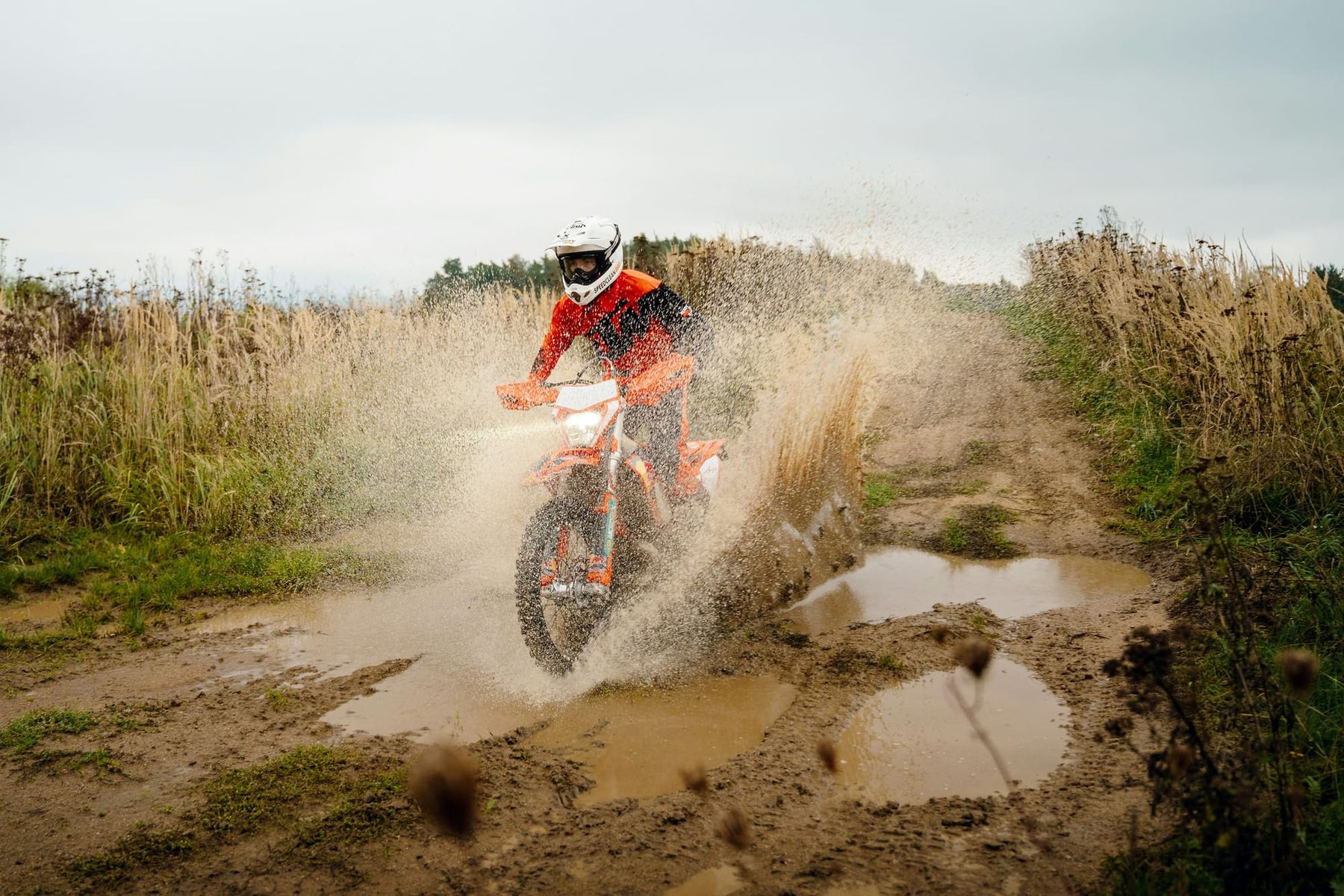
Ask five riders what enduro is and you may receive seven answers.
One will describe a day following route markers through forests and fields, trying to arrive at each time control on the correct minute. Another will talk about riding the same timed test repeatedly. Someone else will describe a mass start, two hours of racing and an increasingly creative interpretation of personal fitness. Then somebody will show you a video of riders hauling motorcycles up a cliff.
All of them may be talking about enduro.
That is what makes the sport initially confusing. Enduro is not one neatly defined race format. It is a family of off-road motorcycle competitions connected by natural terrain, sustained riding, the management of rider and machine, and—somewhere in the system—a clock.
This is the article I wish I had found when I first wanted to understand how it all fitted together.
The short answer
Enduro is off-road motorcycle competition built around riding across natural terrain for a sustained period of time.
Depending on the event, the result might be decided by:
- accumulated special-test times;
- penalties for arriving early or late at time controls;
- the number of laps completed;
- finishing order;
- the time taken to complete the course;
- the number of checkpoints reached;
- or some combination of the above.
Motocross makes its basic logic immediately obvious: everyone races together around a closed circuit. Enduro spreads the competition across a route and asks a wider set of questions.
Can you be fast without destroying the motorcycle? Can you maintain concentration for hours? Can you read the terrain, follow a route, manage your energy and still produce speed when the timed section begins?
That mixture is the connective tissue running through the different forms of enduro.
Where did it come from?
Enduro did not appear fully formed on one particular Sunday afternoon.
Its origins lie in early motorcycle endurance and reliability trials. These events tested whether both motorcycle and rider could survive long distances, difficult roads and limited mechanical assistance. At a time when simply reaching the finish was a meaningful technical achievement, reliability was part of the competition rather than something taken for granted.
One of the clearest historical reference points is the first International Six Days Trial, held in Carlisle in 1913. The event later became the International Six Days Enduro and remains one of the oldest major competitions on the international motorcycle calendar. Over time, its route moved away from ordinary roads and became predominantly off-road. The FIM’s history of the ISDE provides a useful route through that evolution.
Modern motorcycles are rather less likely to shed important components along the way, but the old questions remain: Can the bike last? Can the rider look after it? Can both remain competitive over distance and time?
Traditional or timecard enduro
Traditional enduro—often called timecard enduro in Britain—is the form that makes the rest of the family easier to understand.
Riders normally start individually, often on an assigned minute. They follow a marked route divided by time controls, passage checks and timed special tests.
The day therefore contains two related competitions.
The first is against the schedule. You must travel around the course and arrive at the time controls at the correct time. Arrive late and you may receive a penalty. Arrive early and you may also be penalised. The exact system depends on the event regulations.
The second is against the clock on the special tests. These are the sections where the rider is timed directly and outright speed counts.
Your final result is normally formed from your accumulated special-test times plus any time or other penalties.
The going
Between the special tests and controls is what riders commonly call “the going.”
That innocent phrase can be misleading. The going is not necessarily a gentle liaison ride where everyone relaxes and discusses lunch. It may include narrow woodland trails, mud, roots, rocky climbs, river crossings, ruts, gates and sufficient difficulty to make keeping to the schedule a contest in itself.
It is usually not timed like a special test, but you still have to maintain the event’s timetable. Push too hard and you may exhaust yourself or damage the bike. Take too long and the next control begins to loom.
Good enduro riders are not merely fast. They understand when to attack, when to preserve energy and when a motorcycle stuck axle-deep in a bog requires a more thoughtful strategy than additional throttle.
Time controls and checks
A time control is a designated point where the rider’s arrival time is recorded. Riders work from a timecard or electronic equivalent and calculate the minute on which they are due.
A passage or route check may simply confirm that the rider followed the prescribed course rather than discovering an unexpectedly efficient interpretation of it.
The details vary. Some events use tighter schedules; others give riders more breathing room between tests. The supplementary regulations—the event-specific rules—matter as much as the general championship rules.
If public roads form part of the route, the motorcycle and rider may also need the appropriate registration, licence, insurance and road-legal equipment. That is something to establish before arriving at signing-on, not while somebody is examining your number plate.
Special tests
Special tests are closed sections where riders compete directly against the clock, normally starting one at a time.
Traditional enduro can use several kinds of test:
Cross Test
Usually more open and flowing, often across grass, fields or natural open terrain. It may include cambers, turns, jumps and changes of surface.
Enduro Test
Typically narrower and more trail-like, using woods, streams, roots, rocks, climbs and natural terrain.
Extreme Test
A shorter, more technical test that may include rocks, logs, steep banks, water or constructed obstacles.
Those descriptions are tendencies rather than immutable laws. Organisers have to work with the land available, and the names are used slightly differently in different championships. The current FIM Enduro World Championship regulationsdistinguish Cross, Enduro and Extreme tests, but a local event will not necessarily resemble a miniature EnduroGP round.
Sprint enduro
Sprint enduro takes the special-test element and makes it the centre of the day.
Riders usually complete one or more marked tests several times. Each run is timed, and the times are added together to produce the result. There is generally less route riding, road work and timekeeping than in traditional enduro.
The format sounds simpler because it is. That does not make it easy.
There is little opportunity to disappear into a long day and gradually find your rhythm. Every run matters. Riders have to learn the test, judge grip as the ground changes and produce consistent speed without allowing one overambitious corner to spoil the accumulated result.
Sprint enduro is also a practical way into competition. Events can be held in a more compact area, the process is easier to understand and riders usually get several attempts at the same terrain.
It isolates one of enduro’s central skills: riding quickly over natural ground you cannot completely control.
Cross-country and Hare & Hounds
Cross-country enduro replaces the individually timed special tests with a continuous race.
Riders compete around a longer off-road course for a fixed time, a set distance or a specified number of laps. Starts may be arranged by class or in waves, and the result is usually determined by laps completed, finishing order and elapsed time.
In Britain, Hare & Hounds is one of the familiar versions of this idea.
The challenge is different from sprint enduro. Instead of producing several clean, isolated runs, riders must cope with traffic, deteriorating ground, fatigue and repeated laps. A line that worked perfectly at the start may have become a trench by the time you return.
Racecraft matters. So does passing safely, managing fuel, preserving the motorcycle and recognising that the pace you can maintain for the opening ten minutes may not be a sensible plan for the following two hours.
Cross-country sits comfortably inside the enduro family because it still tests sustained off-road speed, resilience and machine management, even though its result is calculated differently from a timecard event.
Hard and extreme enduro
Hard enduro makes terrain difficulty a central part of the competition.
The course may include severe climbs, rock gardens, rivers, logs, ravines, exposed hillsides and constructed obstacles. Simply reaching the next checkpoint can be an achievement.
Events vary enormously. Some use a prologue to establish starting order. Some are point-to-point races; others use laps or several separate stages. Classification may be based on total time, finishing order or the furthest checkpoint reached before a time limit.
That last point matters. At the hardest events, only a small number of riders may complete the full course. The rest can still be classified according to their progress.
Hard enduro is therefore a description of difficulty as much as a single fixed format. “Extreme enduro” and “hard enduro” are sometimes used interchangeably, although particular championships and governing bodies may use one label in their regulations.
The FIM Hard Enduro World Championship regulations allow considerable freedom in event format, including prologues, sprints, main races and point-to-point competition. That variety is part of the discipline rather than an administrative accident.
The remarkable thing is that many hard-enduro events place elite professionals and ordinary entrants on versions of the same course. They may not be having remotely the same day, but technically they attended the same event.
Rally and all-terrain rally
Rally occupies an interesting position beside the rest of enduro.
Britain’s ACU includes All Terrain Rally within its family of enduro regulations. International rally raid has also developed into a substantial discipline in its own right, with roadbooks, navigation, long stages and its own specialist motorcycles and rules.
The central difference is that navigation becomes part of the competitive problem. Following a roadbook accurately, managing distance and interpreting the route can be as important as outright speed.
For a simple mental map, rally is best treated as an adjacent branch: closely related through endurance, terrain and machine management, but sufficiently specialised that it deserves its own explanation.
Why do the names overlap?
Because motorcycle sport evolved locally.
Different countries had different terrain, land access, clubs, traditions and legal requirements. Organisers developed formats that worked in the places available to them. Some emphasised timekeeping and reliability. Others concentrated on special tests, continuous racing, navigation or technical difficulty.
Championship names also became brands in their own right. “Extreme,” “cross-country,” “classic,” “sprint” and “hard” can describe a rule set, a style of terrain or simply the identity an organiser has chosen for an event.
There is no single global list in which every form of enduro fits perfectly.
The ACU’s current British structure is a useful example. Its core enduro rules are supported by separate regulations for Timecard Enduro, All Terrain Rally, Hare & Hounds, Sprint Enduro and Extreme Enduro. The ACU’s summary of its enduro rules reflects how broad the family has become.
The overlap is not proof that nobody understands the sport. It is the result of more than a century of people adapting off-road competition to different places.
Where does EnduroGP fit?
The FIM EnduroGP World Championship represents the highest international level of the traditional, special-test-based branch of enduro.
A typical championship day combines a route with repeated Cross, Enduro and Extreme tests. Riders must remain fast across different types of terrain rather than specialising in one short circuit or obstacle.
EnduroGP is useful when trying to understand the sport because its tests make the different demands visible. The Cross Test rewards flowing speed and precision. The Enduro Test brings tighter, more natural trail terrain. The Extreme Test introduces shorter, more technical problems.
The overall rider has to be good at all of them—and repeat that performance throughout the event.
And what exactly is the ISDE?
The International Six Days Enduro is one of the defining events in the sport.
First held as the International Six Days Trial in 1913, it has developed into a six-day international enduro contested by national Trophy teams, national Junior and Women’s teams, and club riders.
For the first five days, riders complete substantial daily routes containing special tests and time controls. The sixth day traditionally concludes with a final speed test. To be considered a finisher, a rider must complete all six days.
The distances involved are considerable. The 2026 FIM ISDE regulations recommend a total event distance of approximately 1,200 to 1,600 kilometres, including the final test.
The ISDE retains much of the sport’s original character. It rewards speed, but also consistency, physical endurance, mechanical sympathy, preparation and the ability to wake up the following morning and do it all again.
That is why it carries a significance beyond being another international race week.
So, what actually is enduro?
Enduro is difficult to define neatly because it is not a single format.
It is a broad family of motorcycle competition built around natural terrain, sustained effort and the management of time, route, rider and machine. Some versions reward precision against a schedule. Some reward repeated special-test speed. Others reward race pace, navigation or the ability to keep moving when the terrain appears to have become actively hostile.
The rules change, but the underlying question remains remarkably consistent:
Can you and the motorcycle continue to perform when the ride becomes longer, rougher and less predictable than either of you would ideally prefer?
This article was checked against current FIM and ACU material on 14 August 2026. Regulations change, terminology travels badly and the paddock will always contain at least three confident opinions. If you spot something incomplete or incorrect, tell us. We would rather improve the article than defend a mistake.